


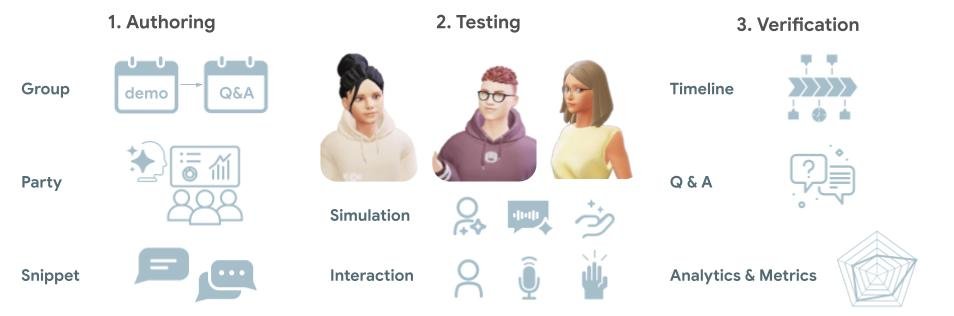
AI talks have changed how we use computers. Talking with AI one-on-one is now very common. But most real talks have many people. Think about team meetings or family meals. These talks have many people talking, changing roles, and interrupting.
It's hard for people who make AI to create these group talks. They can use set scripts, but these are not natural. Or they can use AI that just makes things up, which is too random. We need tools that mix set plans with natural talking.
That's why we made DialogLab. It's a free tool to create, test, and study AI group talks. You can set up scenes, give AI its personality, and control how everyone talks. DialogLab helps you test talks from simple questions to free idea sharing. People who used it said it helps them make better group talks for learning and research.
DialogLab helps you make, test, and study AI group talks. You can set up who is there, how they talk, and then test it. You can also see the talk history and check the results.
A New Way to Make Group Talks
DialogLab separates the people in a talk from how the talk happens. This means you can plan complex talks easily. It has three main steps: make, test, and check.
DialogLab sees talks in two main ways:
- Group setup: This is about the people and their roles.
- A group is the main setting, like a party.
- Parties are smaller groups with jobs, like "speakers" and "listeners".
- Elements are the people (human or AI) and things like a screen.
- How the talk moves: This is about what happens over time.
- Talk is split into snippets. Each snippet is a part of the talk. It has people talking, and rules for how they talk. You can set rules for when people can interrupt or make sounds while others talk. This makes talks feel more real.
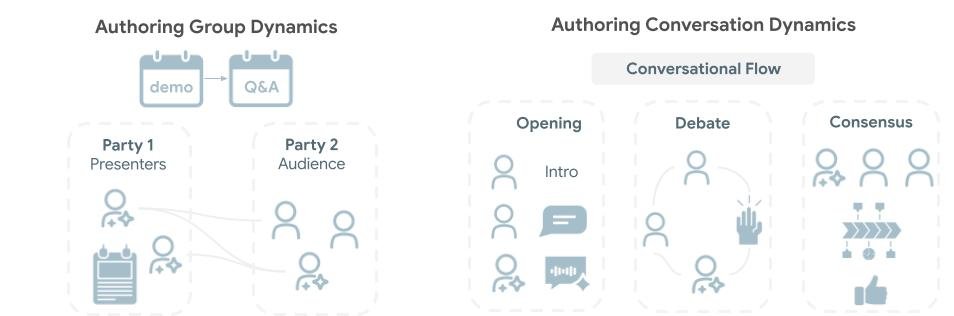
Our system separates who is in the talk from how it flows. This makes planning easier. Left: How to set up speakers and people asking questions. Right: How to plan a talk with opening, talking, and agreeing.
Make, Test, Check Your Talks
DialogLab guides you through making, testing, and checking your talks. It has a visual tool to help you work fast.
- Make with easy tools: You can use a drag-and-drop tool to build scenes. You can set up each person's personality and how they talk in each part. DialogLab can also suggest talk ideas to help you start.
- Test with live help: Testing group talks is very important. DialogLab shows the talk as it happens. It also has a "human control" mode. Here, a helper tool gives you ideas for what the AI could say. You can change these ideas or use them. This lets you change the AI's words and test things fast.
- Check your results: The checking page helps you find problems. It shows how people talk and their feelings. You can see this without reading long talks.
See DialogLab work. It helps you make, test, and study AI group talks.
Testing the tool
We tested DialogLab with 14 people from game design, teaching, and social science. They used DialogLab to plan a social event and test group talks with AI. They tested three ways AI could talk:
- Human control: You can tell the AI to "change subject", "give new ideas", "ask a question", or "show feelings".
- Automatic: The AI talks by itself. It changes the subject and shows feelings on its own.
- Reactive: The AI only talks when someone talks to it. This is like normal human-AI talks.
People liked the "human control" way the best. They said it felt more real and fun. They used a rating scale to say how good each way was.
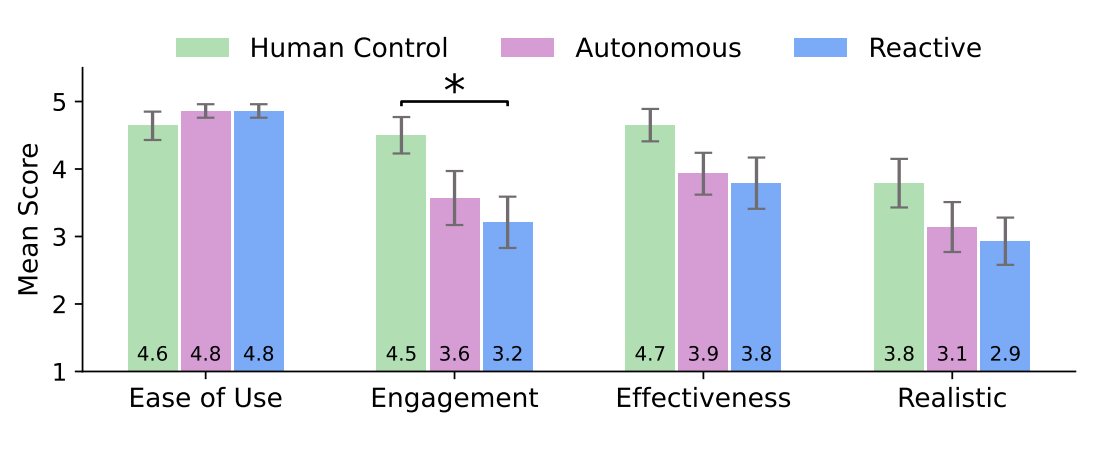
This chart shows how good the Human Control, Automatic, and Reactive AI talks were. It compares how easy they were to use, how fun they were, how well they worked, and how real they felt.
People said good things about DialogLab:
- Easy and fun: Most people said DialogLab was easy to use. The drag-and-drop tool to make scenes was quick and fun.
- Works your way: Users liked that they could change AI suggestions. They also liked that the tool could show different ways of talking.
- Real talks: The "human control" way was the best for testing. Users felt more in charge and felt more part of the talk. It was better than AI talking all by itself or only when spoken to.
- Helps find problems: The checking tool was useful. It let people quickly see how talks went without reading everything.
What's next
DialogLab is not just a test tool. It's a step to better human-AI talks. You can use it in many ways:
- Learn new skills: Students can practice talking in front of fake people. Workers can practice hard talks or job interviews.
- Make games and stories: Game makers can create better fake characters (NPCs) that talk like real people.
- Study how people act: DialogLab gives a good way to study group talks. It is easier than finding many people for a study.
See how DialogLab can be used for practice talks, debates, and making game stories.
In the future, we can add more things. Like non-verbal actions and faces. We could also use real-looking people and 3D places like ChatDirector. This will make talks even more real. We hope this work helps create new ideas for human-AI group talks. It's a new and exciting field.
Watch the video to learn more about DialogLab.