


7 Small AI Models to Run on Your Laptop
You can now run powerful AI on your own computer. The models below work on regular laptops. They give good results for specific jobs. You might need to agree to license terms to download some models. Once you have the model files, you can run them without the internet.
This guide shows you seven useful small AI models. We rank them by how well they fit different jobs, not just speed tests. All of them have been used in real projects. You can run them on hardware you probably already have.
Important: Small models get updates often. New files, longer text limits, and new tags appear. This guide helps you pick the right model family. Always check the official model page or Ollama for the latest details, license, and settings before you use them.
1. Phi-3.5 Mini (3.8 Billion Parameters)
Microsoft's Phi-3.5 Mini is a great choice for developers. You can use it to build AI systems that find information in your own data on your laptop. It came out in August 2024. Many people use it for apps that read long documents without sending data to the cloud.
Reads lots of text. Phi-3.5 Mini can read very long texts. This makes it good for finding information in many documents. Many other models with 7 billion parameters can only read shorter texts. Some versions might use shorter text limits by default. Check the settings before you need to read very long texts.
Best for: Reading and understanding long texts · Writing code · Finding answers in your documents (RAG) · Working with different languages
Hardware: Needs about 6-10GB of RAM for common use. More RAM is needed for very long texts. Full versions need 16GB RAM. A modern laptop with 16GB RAM is recommended.
Download / Run: Get the Phi-3.5 Mini Instruct files from Hugging Face. Look for microsoft/Phi-3.5-mini-instruct. Follow the instructions there. If you use Ollama, type: ollama pull phi3.5. Check the Ollama page for details on the version and settings.
2. Llama 3.2 3B
Meta's Llama 3.2 3B is a model that does many things well. It follows instructions nicely and is easy to adjust. It's also fast enough for apps you use often. If you don't know where to start, try this model.
Good all-around. It's not the best at one single thing, but it's good at many tasks. Meta supports 8 languages. The training data includes more languages too. It follows instructions very well, making it useful for many jobs.
Best for: Talking and answering questions · Making text summaries · Sorting text into groups · Helping customers with automated answers
Hardware: Needs about 6GB of RAM. Full versions need 12GB RAM. At least 8GB RAM is needed for it to run smoothly.
Download / Run: Find it on Hugging Face from the meta-llama group. You need to agree to Meta's license terms. For Ollama, use this command: ollama pull llama3.2:3b.
3. Llama 3.2 1B
The 1B version is smaller. It uses fewer resources but is still useful. This is the model you use when you need AI on phones or small computers. It works well when you have very few resources.
Can run on phones. A small version of the 1B model fits in 2-3GB of memory. This means it can run directly on your phone. Privacy is better, and you don't need an internet connection. How well it works depends on your phone. Good phones can run it.
Best for: Simple tasks like sorting text · Basic questions in a specific area · Reading simple logs · Running AI on phones and small devices
Hardware: Needs about 2-4GB of RAM. Full versions need 4-6GB RAM. High-end smartphones can run it.
Download / Run: Find it on Hugging Face from the meta-llama group. You might need to accept the license. For Ollama, use this command: ollama pull llama3.2:1b.
4. Ministral 3 8B
Mistral AI made Ministral 3 8B for systems where space is limited. It performs like bigger models (13 billion parameters) but uses less power. It's a good choice for laptops when you want more power than 3B models.
Very efficient for small spaces. The Ministral models are made to give good results quickly on regular computers. They use smart ways to work faster, so the 8 billion parameter count is very effective.
Best for: Thinking through hard problems · Having long conversations · Writing code · Tasks that need careful understanding
Hardware: Needs about 10GB of RAM. Full versions need 20GB RAM. 16GB RAM is recommended for easy use.
Download / Run: There are different versions of the Ministral models. Older versions have different licenses. Newer Ministral 3 models use an Apache 2.0 license, which is better for business use. For an easy way to run it on your laptop, use Ollama: ollama pull ministral-3:8b. Make sure your Ollama is up to date. Check the Ollama model page for the exact version and license.
5. Qwen 2.5 7B
Alibaba's Qwen 2.5 7B is excellent for coding and math. If your work involves writing code, looking at data, or solving math problems, this model is better than others in its size group.
Specialized for certain jobs. Qwen was trained a lot on code and technical topics. It understands how code works, can fix bugs, and creates code that works more often than other general models.
Best for: Writing and finishing code · Solving math problems · Understanding technical texts · Working with Chinese and English
Hardware: Needs about 8GB of RAM. Full versions need 16GB RAM. 12GB RAM is recommended for the best results.
Download / Run: Find it on Hugging Face from the Qwen group. For Ollama, use this command: ollama pull qwen2.5:7b-instruct.
6. Gemma 2 9B
Google's Gemma 2 9B is the largest model on this list. At 9 billion parameters, it's heavy, but it's as good as 13 billion parameter models. Use this model when you need the best quality your laptop can offer.
Safe and follows instructions well. Gemma 2 was trained with a focus on safety. It is less likely to respond to bad requests. It also follows complex, multi-step orders accurately.
Best for: Following difficult instructions · Tasks needing careful safety checks · Answering general knowledge questions · Checking content
Hardware: Needs about 12GB of RAM. Full versions need 24GB RAM. 16GB RAM or more is recommended for real projects.
Download / Run: Find it on Hugging Face from the google group. You need to agree to Google's license terms. For Ollama, use a command like: ollama pull gemma2:9b-instruct-*. Ollama offers different versions. Choose the one that fits your needs.
7. SmolLM2 1.7B
Hugging Face's SmolLM2 is one of the smallest models. It's made for trying things out quickly and learning. It's not ideal for big projects, but it's perfect for testing new ideas and seeing how small models work.
Fast and easy to use. SmolLM2 runs in seconds. This makes it great for testing your ideas fast. Use it to check your setup before you try bigger models.
Best for: Trying out ideas quickly · Learning and testing · Simple text tasks (like finding feelings in text) · School projects
Hardware: Needs about 4GB of RAM. Full versions need 6GB RAM. It can run on any modern laptop.
Download / Run: Find it on Hugging Face from HuggingFaceTB. For Ollama, use this command: ollama pull smollm2.
How to Choose the Best Model
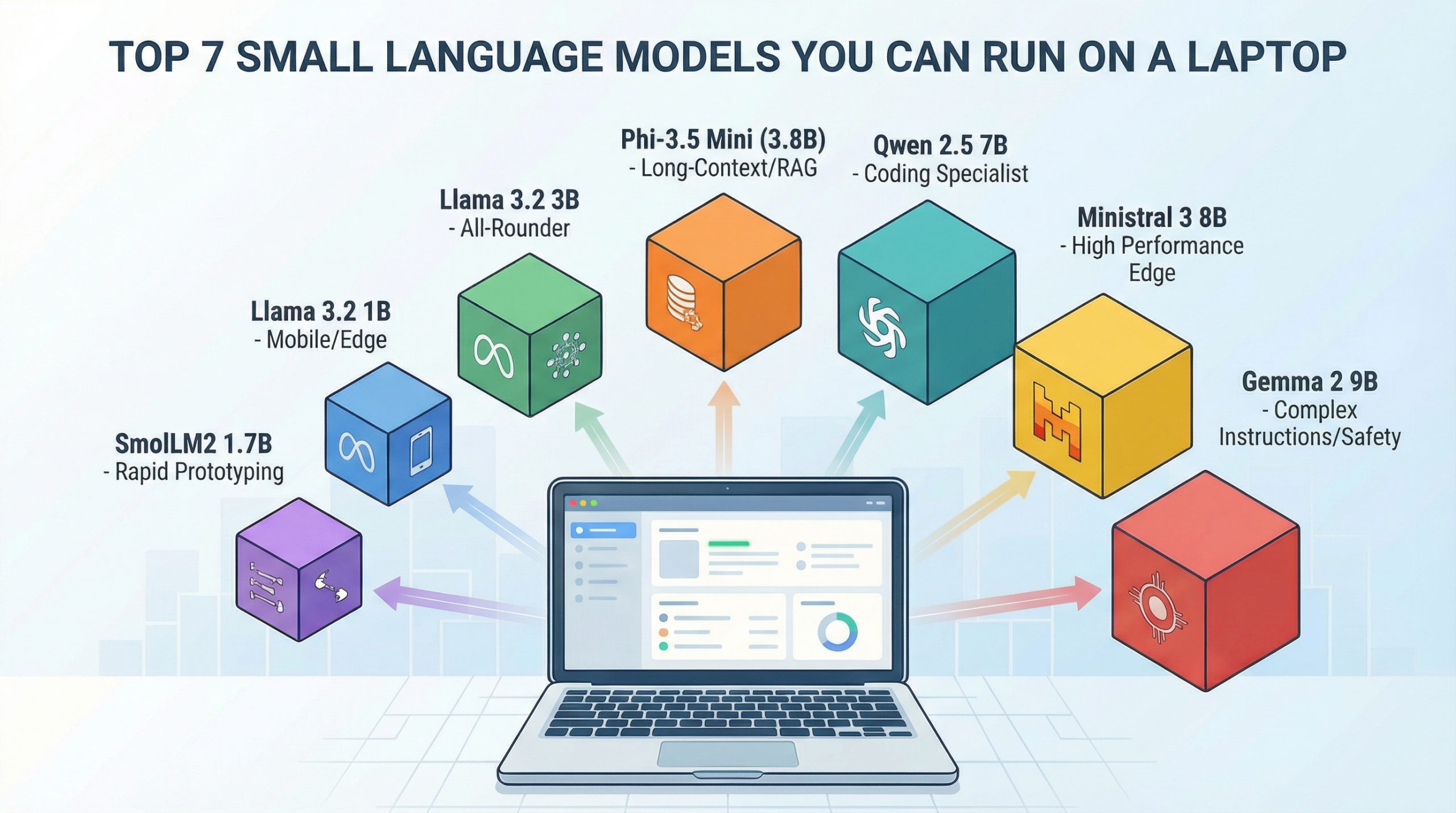
The model you pick depends on what you need and what you have. For reading lots of text, choose Phi-3.5 Mini. If you are new, Llama 3.2 3B is a good, flexible choice. For phones and small devices, Llama 3.2 1B is the smallest. If you want the best quality on your laptop, use Ministral 3 8B or Gemma 2 9B. If you work with code, Qwen 2.5 7B is the best. For quick tests, SmolLM2 1.7B lets you try things very fast.
You can run all these models on your computer once you get the files. Some models, like Llama and Gemma, need you to agree to terms. You might need a special code to download them. Model details and default settings change often. Always check the official model page or Ollama page for the latest license and settings. You can use tools like llama.cpp to run smaller, optimized versions of these models.
It's now easier than ever to run AI on your own hardware. Pick a model, try it out for a day with your task, and see what you can create.