Smartwatch Gait Analysis: Accurate Health Insights from Your Wrist

DeepGeek
المؤلف DeepGeek
تاريخ النشر
آخر تحديث
Smartwatch Gait Analysis: Accurate Health Insights from Your Wrist

Gait metrics help us understand your health. They show your walking speed, step length, and how long both feet are on the ground. These metrics are important signs. They can show your risk of falling. They also show problems with your nerves or muscles. Watching how you walk, called gait analysis, gives helpful health information. It does this without needing to go inside your body.

Before, measuring gait needed costly lab tools. This made it hard to track walking all the time. Now, smartphones can help. They use built-in sensors. But you must place them just right, like in a front pocket or on a belt. Smartwatches are worn on the wrist. They stay in one place. This makes them better for constant tracking. You can even track your walk without your phone.

But smartwatches have not been as good as phones for checking many walking details. Our study, "Smartwatch-Based Walking Metrics Estimation," aimed to fix this. We showed that smartwatches can accurately measure many walking metrics. They work as well as phones. This makes them a good choice for tracking your walk.

A deep learning approach for the wrist

We used a special computer learning method. It is a deep learning model. It works for both smartwatches and smartphones. This model can guess many things at once. It uses a TCN architecture. This is different from other models. Older models only found walking events. You had to guess the distance from that. Our model directly guesses walking details like step length and speed.

Our model needs two main things. It needs your height. It also needs the sensor signals from the watch. This includes data from the accelerometer and gyroscope. We used a Pixel Watch. It sent data 50 times every second. The model learns from these signals. It then adds your height. Finally, it guesses all the walking details. It guesses speed and how long both feet touch the ground. It also guesses step length, swing time, and stance time for each foot. Here are the details:

  • Gait speed: How far you walk divided by the time it takes (in cm/s)
  • Double support time: The time both feet are on the ground (in %)
  • Step length (unilateral): The distance from one foot landing to the other foot landing (in cm)
  • Swing time (unilateral): The time your foot is not touching the ground (in ms)
  • Stance time (unilateral): The time your foot is touching the ground (in ms)

We used 5-second chunks of data. We overlapped them by 1 second. We used MAPE to check how well the model worked. MAPE measures the average error. It helps the model guess distances and times correctly.

Rigorous validation in a large-scale study

We tested our model with many people. There were 246 people in our study. We looked at about 70,000 walking parts. People in the study were over 18. They did not use walking aids. They had no balance or walking problems.

We used a special floor called a Zeno Gait Walkway. This measured walking exactly. People wore a Pixel Watch on each wrist. They also carried four Pixel 6 phones. The phones were in different places: front pocket, back pocket, backpack, and a bag across the body.

People walked in different ways for the test:

  • Six minute walk test (6MWT): Walked around a track for six minutes. They walked at their own speed.
  • Fast pace walking: Walked fast but steady.
  • Mild and moderate asymmetry: Walked with a knee brace that changed how they bent their knee.

We trained the smartwatch model using data from both watches. We tested the phone model using data only from front and back pockets. These are the most common places people keep their phones. We used a method called five-fold cross-validation. This means we split the data into five parts. We used four parts for training and one for testing. This helps make sure the test results are fair.

Key findings

The results showed that the smartwatch method is accurate. It works as well as the phone method. The phone model was trained with more data. But the smartwatch model worked just as well.

  1. Strong validity and excellent reliability: The smartwatch estimates were very good. They matched what the Zeno walkway showed. The correlation was high (Pearson r >0.80). The reliability was also excellent (ICC >0.80) for most metrics. This includes walking speed, step length, swing time, and stance time. Double support time was a bit less reliable but still good (ICC 0.56−0.60).
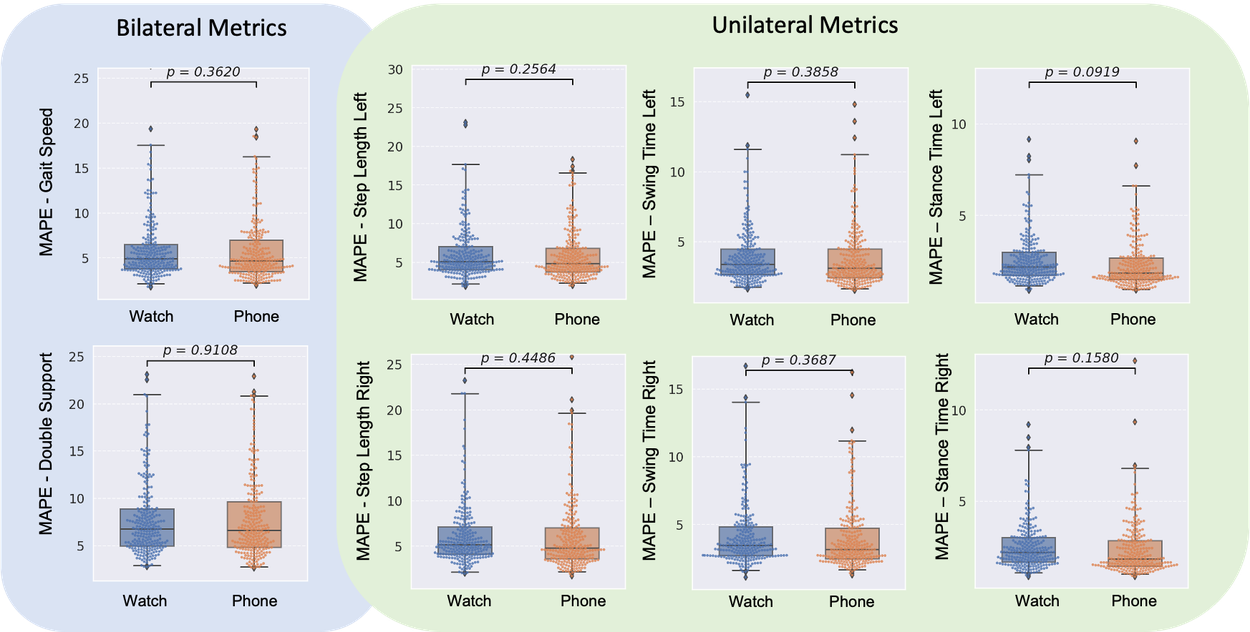
  2. Comparable to Smartphone Estimates: We compared the errors. The smartwatch and phone had similar errors (MAPE and MAE). This means the smartwatch is a very good option for checking your walk. Both the smartwatch and phone were much better than a simple guess.
  3. The role of user height: We found that knowing the user's height made the smartwatch better. It improved the guesses for walking speed and step length. This shows height is important for watches to measure walking well.
Box and swarm plots comparing Watch vs. Phone Mean Absolute Percentage Error (MAPE) for eight bilateral and unilateral gait metrics.

Gait parameter accuracy reflecting the mean absolute percentage error (MAPE) for Pixel Smartwatch (Watch) and Pixel Smartphone (Phone) (N=246 participants). Boxes indicate the interquartile range (Q1–Q3), whiskers show 1st–99th percentiles.

Impact and future directions

This is a big step. Now, smartwatches can help track your health accurately. We can now check your walking details easily. This can help us:

  • Continuous and accessible tracking: Track your walking over time. Do this outside of the lab or doctor's office.
  • Early detection and prevention: Find health problems early. Help prevent falls. Plan how to get better after an injury.

The smartwatch is easy to use. It tracks your health well. It works better than phones that need special placement. We will keep working to make our methods even better. We want to help you stay healthy using your smartwatch.

#smartwatchgaitmetrics #gaitanalysis #wearablehealthtracking #steplengthestimation #gaitspeedmeasurement #deeplearning #healthinsights
أضف تفاعلك على هذا المقال

Commentaires

عدد التعليقات : 0